Nobody designs a boiler room for the boiler to leave. The equipment was set before the walls were closed, before the door frame went in, sometimes before the floor above was poured. Thirty years later the building wants it gone, through a 36-inch door and up a stairwell with a landing. That is the whole job, and it is why a boiler leaves in pieces.
Cast iron: it was built in pieces, so it comes apart in pieces
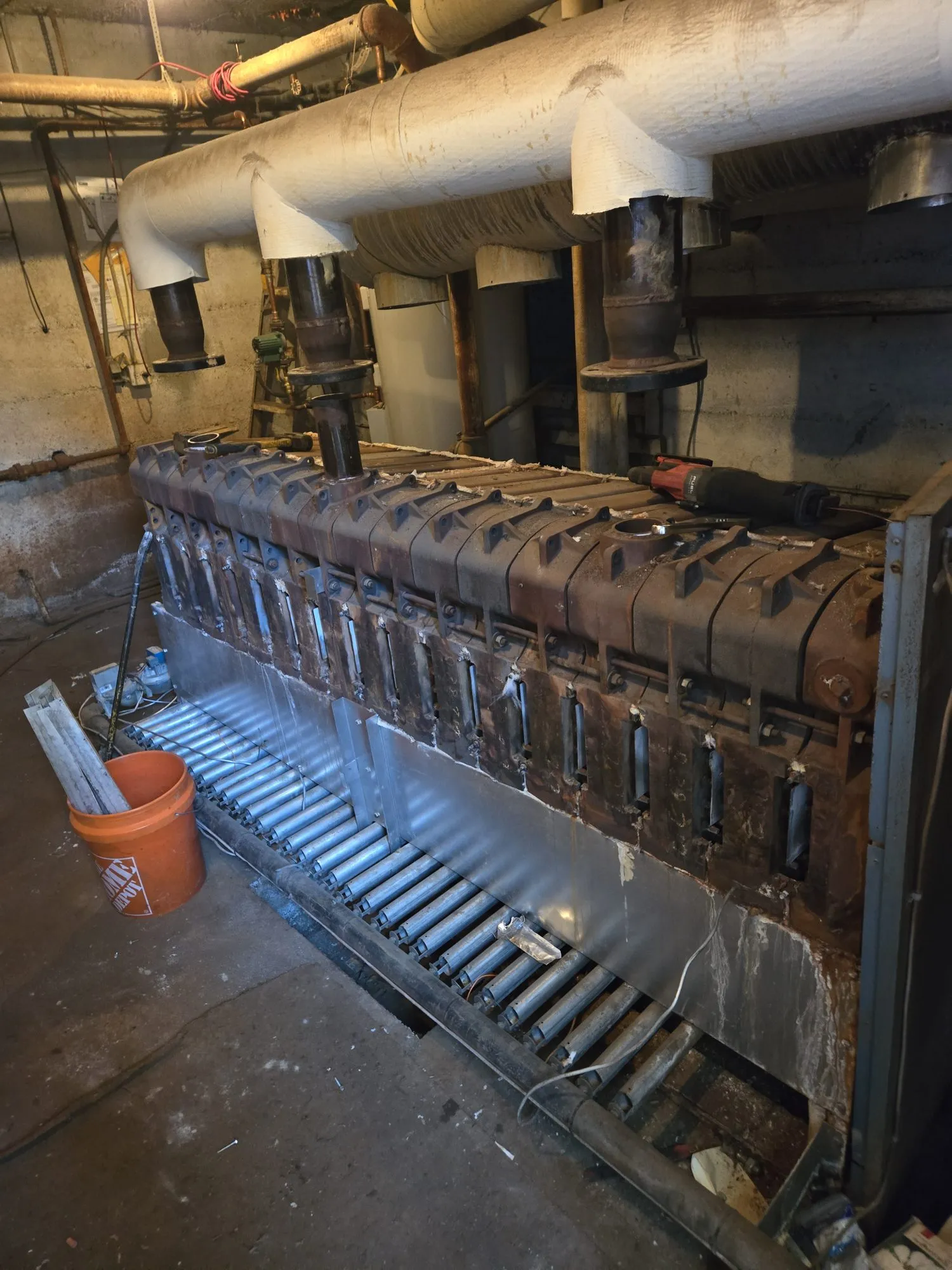
A cast iron sectional boiler is a stack of vertical sections, each one a hollow casting with water inside and flue gas outside, held together by push nipples or tie rods and sealed at the joints. A residential unit might have four sections. A school boiler might have seventeen. Each section can weigh anywhere from a couple hundred pounds to seven hundred.
Taking one apart is disassembly more than demolition. Jacket, burner, controls and flue come off first. Then the tie rods, and then the sections are split one at a time, back to front. The first ones come easy. The last few have been sitting in each other’s rust for decades and fight back, and this is where the experience shows: knowing where to pry, where to cut a nipple instead of forcing it, and when a section is about to let go.
Each section then rides a skate or a dolly to the door, and if there are stairs, up them, one at a time, with the load rated for the person moving it. Seventeen sections and the piping around them has been a one-day job for us when the room had a straight shot to the truck. The same boiler in a basement with two turns and a landing is a different day, and the proposal says which one you are getting.
Firetubes: one welded vessel, so the torch decides
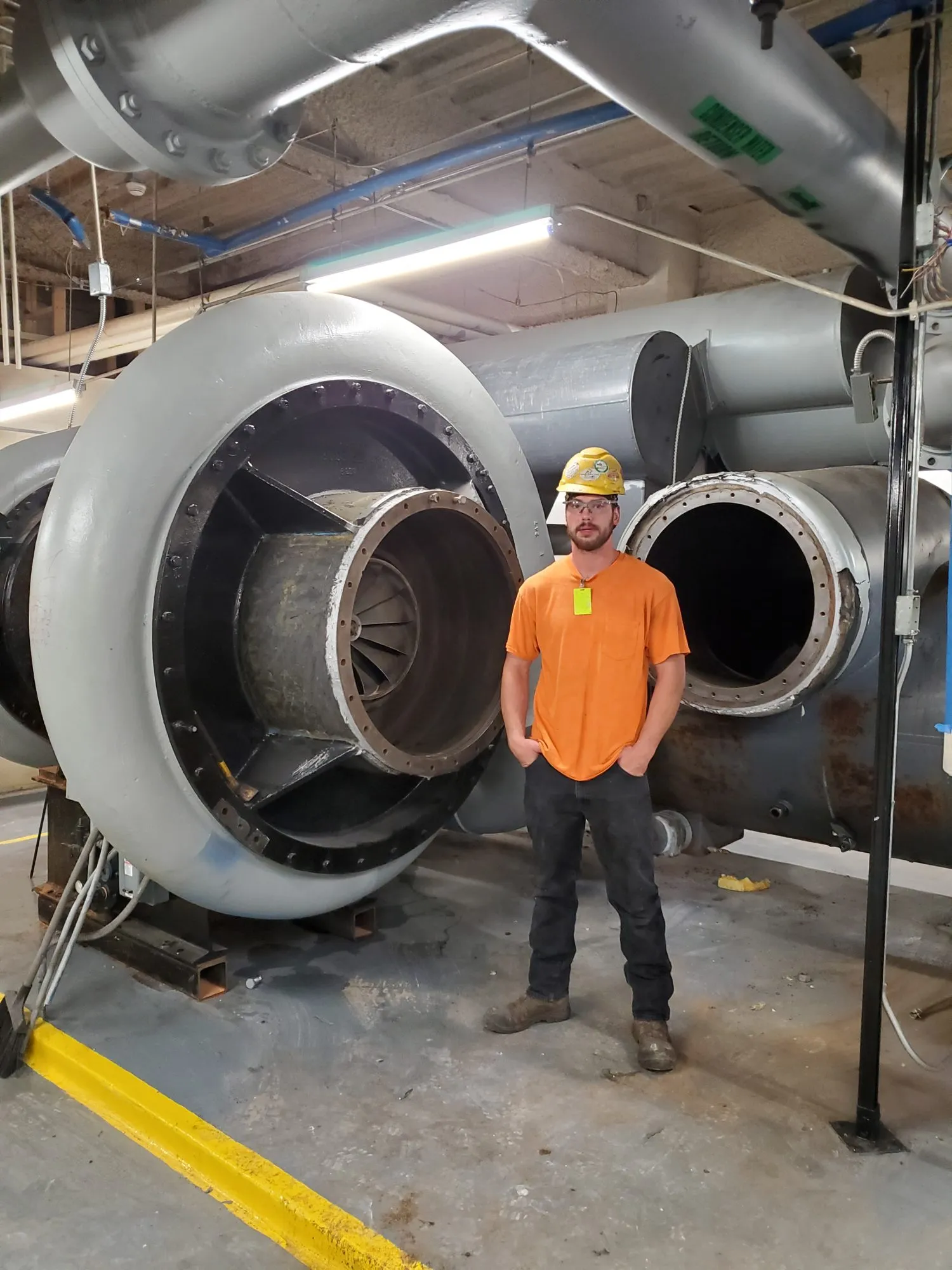
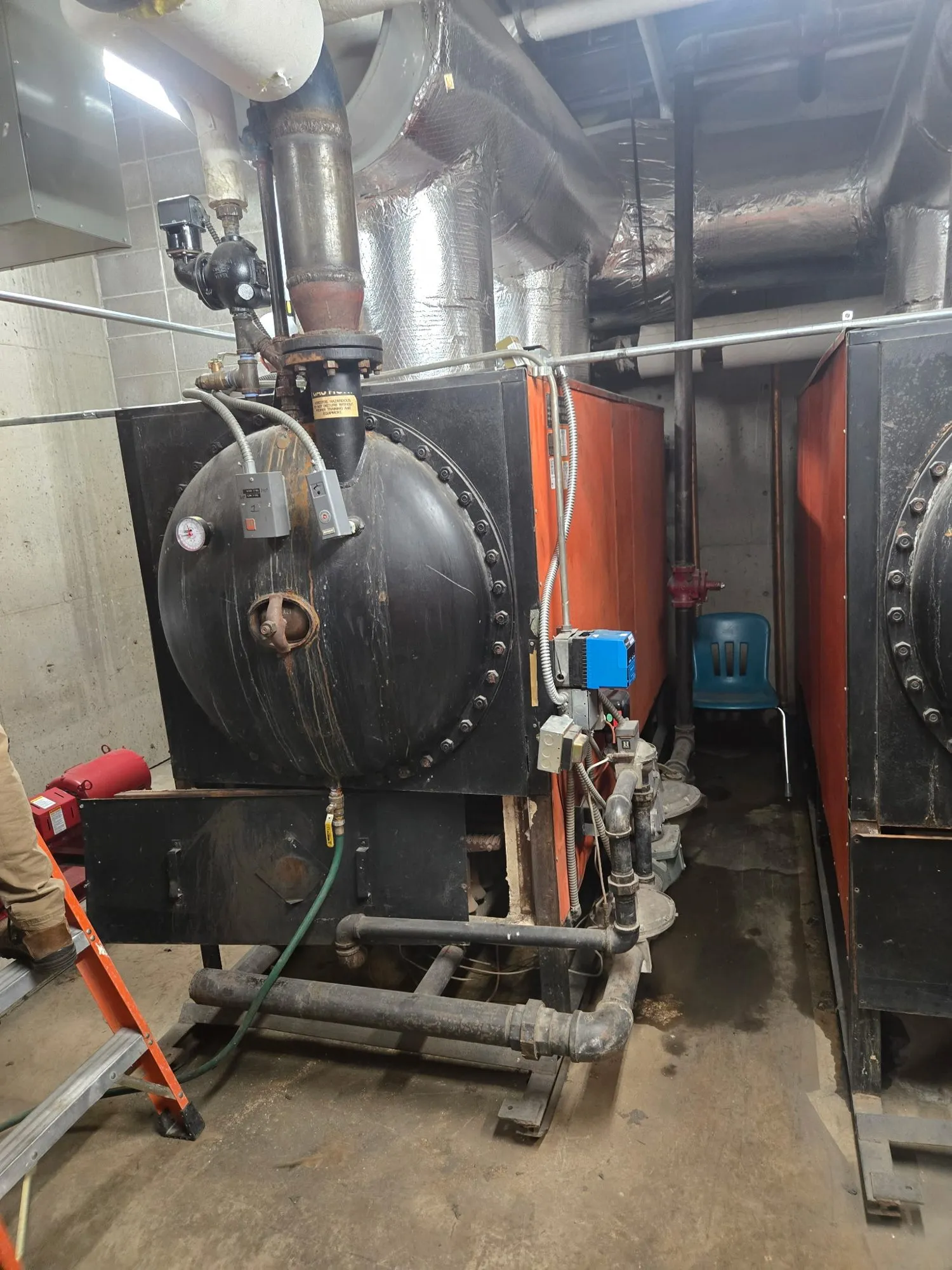
A firetube boiler is a pressure vessel: a steel shell with tube sheets welded at each end and a bundle of tubes running through it, with the burner firing into a furnace tube. Nothing about it unbolts. It was welded shut in a factory and it leaves the way it arrived, as steel, except now the steel has to fit through a door.
The sequence is about the same on every firetube. Burner and controls off. Flue and breeching down. Jacket and insulation off, and this is where old insulation gets a hard look, because pre-1980s jackets can hide asbestos, and that stops the job until a licensed abatement contractor clears it. Then the cuts: the shell gets sectioned into panels and rings sized for the path out, the tube sheets come off, and the tube bundle is cut into lengths two people and a skate can move. The pieces are heavy, sharp and hot for a while, so the order matters: nobody is working under a cut that has not landed.
On a two-boiler school plant this year, two 4-million-BTU firetubes plus six expansion tanks, a heat exchanger and the connecting pipe came out in three working days that way, with the pieces sized for a basement stairwell and staged at the door for the truck.
Watertube and flex-tube: casing first, then the headers
Watertube and flex-tube boilers put the water in the tubes and the fire around them, inside a casing. Those come apart casing first, then the tube panels or coils are cut free of the headers, and then the headers and drums are sectioned. They are lighter per piece than cast iron and less monolithic than a firetube, and the challenge is usually the number of pieces rather than the weight of any one.
Deciding where to cut
Before the torch is lit, someone with a tape has walked the path: the door width, the stair width and rise, every turn, the elevator car, the truck bed, the floor loading between here and there. The heaviest piece we plan to make has to be safe for the people moving it and for the building under it. On the big ones the weights come from nameplates and from the geometry; on the strange ones we do the math and write it down.
Then the cuts get made where they do the least harm: away from refractory that will crumble, away from insulation that might be more than insulation, and in an order that keeps every piece supported until it is meant to move. When a section can travel whole to a loading dock or a parking lot, the heavy flame work goes outdoors and the room stays cleaner.
The biggest one
The largest boiler we have taken out was a 52-million-BTU unit at an industrial plant in Fort Morgan in 2020, a machine you could park a truck inside. It left in two weeks with three people: two cutters working all day and one on a forklift running each piece from the boiler to a roll-off. That pace was possible only because the plant had wide-open access. Put the same boiler in a basement and it is four or five people over two or three weeks, and the estimate says so up front.
What to ask a demolition contractor
How big will the pieces be, and how did you decide? What is the path out, and who measured it? Who is on fire watch while the torch is running? A crew that does this every week has walked the path before they answered the phone.